
Introducing The Levels Of Trust
A flowchart and system for understanding and determining trustworthiness.

Good Afternoon Honeycomb Folks,
Today I am writing about a topic and a system that is SEVEN years in the making. This will eventually become a full-fledged workshop that will include both online and in-person versions. However, I have been hoarding this knowledge and idea out of fear; fear of someone stealing my idea and more successfully bringing it into the world; fear of not being capable of doing justice to this idea which deserves a lot of attention and care; and fear of failure, of course, fear that when I do finally share this idea with the world that it will be rejected or worse ignored and it will fail to reach the thousands of people who would truly benefit from this system I’ve built.
However, today, in the last few hours of Cancer season, with Mercury Retrograde in Leo (and several other transits but this is not an astrology blog), I am finally sharing my work! This whole thing is a rough draft of future more refined details and explanations, but I’m facing my fears and sharing it with you.
Big shoutout to
for inspiring me to work on this today. In their most recent article they talked about social anxiety with this paragraph:I developed social anxiety because I didn't know how to determine if people were safe people (or not), and kept sharing with, getting close to, and being hurt by people (because I couldn't sense what people were genuinely kind and actually liked me, vs those who were only "being nice" because they wanted something from me).
I feel like this is such a common challenge people, especially neurodivergent people like Lyric and myself, deal with and it is my strong hope that this system I developed might be a useful tool for anyone struggling with determining whether someone is safe and trustworthy.
So what is this concept and what are these Levels of Trust?
The Levels of Trust is a flowchart I created in 2018 and refined in 2021 and 2023. The purpose of this flowchart is to create a visual reference guide to help people more fully understand trust and how it can be measured and categorized in our relationships.
The flowchart (down further in this article) is designed with two axes of measurement: relative safety and impressions over time. The chart begins on the left with meeting a person.
Every time we meet a person they give us some kind of impression. This is a well-known phenomena called the First Impression. While we all understand what a first impression is and how important that impression can be, we are never really taught why that impression is important.
That First Impression is the first of many impressions we have with other people and those impressions are how we ultimately determine how much we can trust a person.
Impressions can be categorized in three ways: constructive or positive impressions; neutral impressions; and destructive or negative impressions. I use the terms constructive and destructive when referring to impressions because every impression with a person is either building or destroying our trust in that person.
So when we meet someone and they make their first impression on us, that impression falls into one of those three categories which is why following meet there are three Levels of Trust shown. These levels can be called whatever you like that makes sense to you, but in MY flowchart, these levels are 4. Squad (constructive impression), 5. Acquaintance (neutral impression) and 6. Follower (destructive impression).
Note that this is all super personal and relative; the idea of this flowchart and the system behind it is to help people develop and organize their own levels of trust and their own types of impressions and basically customize the system in a way that makes the most sense for them.
The flowchart continues on with arrows that indicate direction of movement through the chart. The length of the arrows on the flow chart loosely indicates the number and strength of impressions or amount of time that could be required to move between the two levels the arrow is between. For example, between our middle levels of trust the arrows are shorter than the arrows along the top and bottom of the chart. This is designed to indicate where movement between levels may be more and less frequent and likely.
The top three levels on the chart indicate levels of more trustworthiness and safety, while the lower three levels indicate levels of less trustworthiness and unsafety. As a person establishes constructive or destructive impressions throughout your relationship with them, they move either up or down on the flowchart, depending on the most frequent or strongest type of impression.
It’s also important to clarify that not all constructive and destructive impressions are of equal weight when it comes to trustworthiness. Some impressions like physical harm are so destructive they might put a person quickly into the lowest level on this chart. A single significant impression of loyalty and unwavering support might move a person a whole level up the chart.
The final level on the chart, numbered 7 for its relative position in the rankings of trustworthiness I have labeled Limbo/Probation. I originally called this one Purgatory but changed it to make it feel less heavy. However this is a heavy level, and a unique one. It is designed as a place to relegate trustworthy people in our lives who in some way have “broken” our trust. Someone who previously had primarily constructive impressions and had moved into one of the upper levels of the chart gave us a fairly significant destructive impression.
Things like stealing, lying, cheating, harm, abuse, betrayal would all be a destructive enough impression to move a person swiftly into that Level 7 zone. Now they are untrustworthy and will have to work hard to regain trustworthiness with you.
You may also notice that there is no arrow leading from level 7 back to levels 1 or 2. This is designed to indicate that once a person has fallen down to Level 7, they probably should not be quickly or easily allowed back into the upper two levels of trustworthiness.
Significant constructive impressions, such as reparations or amends, can move them back into trusted territory (Level 3); or with further destructive impressions this person may move further down into the lowest levels of untrustworthiness. All of the arrows on the chart are still valid for this person though and they can work to move in either direction on the chart, following the path laid by the arrows over time.
The V shape in this chart is sort of important as well. There isn’t an indicator on the chart (maybe I’ll add one) but I consider the placement of the levels relative to time; but also relative to how close you let them get to you and how much of your time, energy and effort you might give them. The invisible you on this chart is right above the blue Level 1 zone and the Safe rating on the chart scale on the right. That upper right corner is you and all the levels and their placement indicate the proximity of people in those levels to you.
Levels 9 and 10 seem closer to that invisible you than levels 4, 5, and 6 and that’s deliberate, because when someone has indicated that they’re untrustworthy and unsafe, it’s important to be mindful and vigilant around those people and therefore they will get more attention than someone you don’t know well or who has a more neutral trust rating in your mind.
Okay that’s a lot of detail about the chart and what it means and how to read it. So here it is, my most precious idea, for you to see. I realize that sharing it here now, where have been getting less than a single view on my substack articles, it may not get many more views than the half dozen or so its already had. However, the point today is not necessarily to get eyes on the project, but to put the project into the world and build some momentum for me working on the other components of the project and continue to flesh out the ideas behind it. But anyway here’s version 3.0 of the Levels of Trust flowchart:
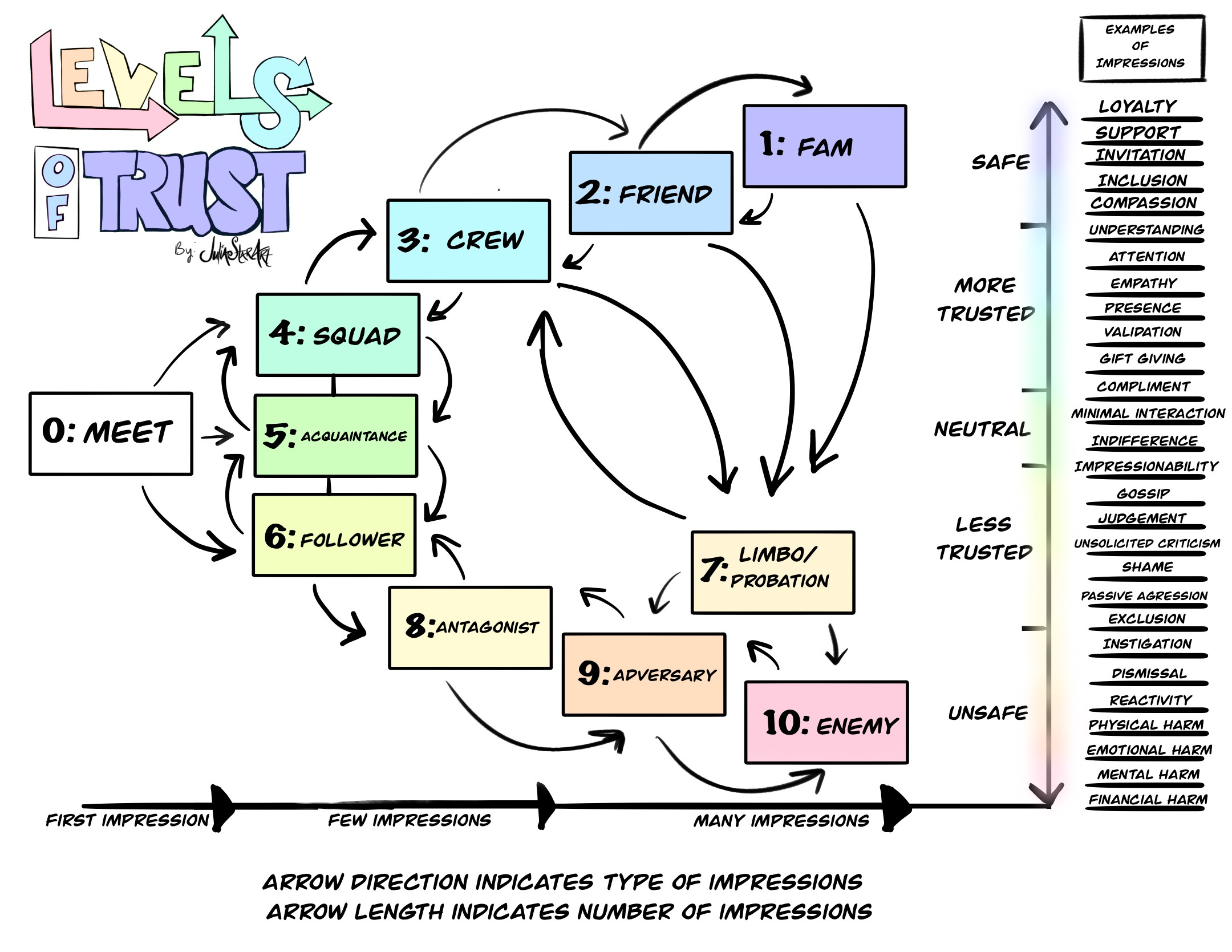
It’s important to note that this chart is designed to remain fluid and flexible. People will gain and lose trustworthiness throughout the course of your relationships with them. This chart is merely a tool to increase our mindfulness of that movement and to remind us that Trust is not just a static state but a dynamic metric as I have illustrated with the Levels of Trust.
I may create a series on this topic with regular posts about my progress, kicking around ideas and deep diving into the history of this idea for me and how I got here. Might make them Trust Tuesdays, but for now this is enough.
I hope you enjoyed reading about my idea and I would love to hear what you think so far in the comments. (all comments are open for everyone and like these words are not paywall-blocked)
Thank you for taking the time to read about my idea and for any feedback you leave, it means the world to me.
Love,
Jules
A beautiful nuanced piece on trust levels to dive into over and over again. Thank you for this thoughtful and well-written article, Julia. I’m excited for more!